
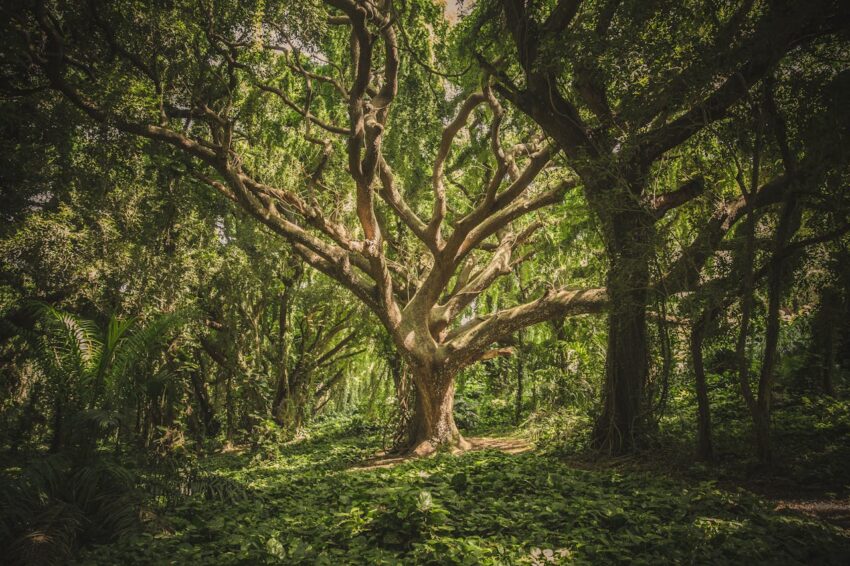
“And the LORD God planted a garden eastward in Eden; and there He put the man whom He had formed” (KJV)
The garden of Eden and the two trees described in Genesis 2-3 have a particular significance in biblical exegesis.
Garden of Eden
The garden as alluded to in post 2, was the perfect domicile that God chose for Adam and Eve, a most pleasant place flourishing with fruit-yielding trees, life-giving water, and mineral-rich deposits. It was a perfect symbol of the true paradise of God in the New Jerusalem (Rev 21:2,10-12). It had a gate in the east, implying it had a single entrance (3:24). In spiritual terms, the single gate speaks of Christ as the unique door and entrance to God (John 10:9, 14:6). Furthermore, in the holy city there are found to be twelve gates, each depicted as a pearl which is a figure of Christ’s redemption (Rev 21:12, 21; Matt 13: 45-46). After Adam fell, this Edenic gate was blocked off to him and his posterity with the cherubim guarding it with flaming swords (3:24). The spiritual significance of this blockade was that access to God and the immortality bestowed upon the tree were cut off from humanity. For Adam, the unbroken, direct access he had had to God suddenly became broken and interrupted.
The two trees
There were a multitude of trees in the garden, all good for food except the tree of knowledge of good and evil. Prominent among all the trees was the tree of life, as suggested by God naming it and placing it in its center (Gen 2:9). It is worthwhile to note that the tree of knowledge of good and evil was also placed in the middle of the garden, as observed by Eve in 3:3. By placing both trees in the “middle of the garden”, it appears that God wanted Adam to make a willful choice between the two, with His desire that Adam would choose the tree of life while shunning the other.
It’s a logical fallacy to think that the two trees were only symbolic in nature. They embodied the spiritual realities of eternal life and death. Luther in contradiction to his own principle of literalism falls into the error of reducing the significance of these trees to mere symbolism. He attributes the effects of life and death to mere obedience and disobedience. He claims what gave the qualities of the two trees was solely God’s speaking and His interdiction of partaking of the tree of knowledge of good and evil. By this he falls for the same kind of symbolic misinterpretation that he accuses the church fathers of. God’s words were declarative, an affirmation of a principle already at work, which was that the tree of knowledge of good and evil was stricken with sin with its effect of death or mortality. If we deny this, we plunge into mental absurdities about explanations on how sin entered into man, some of which include questions like – did sin enter into man mystically or some other mysterious way? was it a spirit who imparted sin into man or was it a creature? if a creature, was it the serpent? if the serpent, did he “breath” sin into Adam? As one can see, this line of inquiry quickly devolves into utter nonsense. We will delve more fully into the fall of man in another post.
The physical garden of Eden was likely destroyed in the ensuing flood several centuries later where both trees perished. This leads us to a metaphysical quandary – how can one say the tree of life had perished if it held the essence of immortality? Let us explore this dialectic a bit. First, let us remember that even though mortality and immortality were bestowed upon the two trees, they were still physical emblems of the spiritual reality. Secondly, we need to acknowledge that if God has the power to bestow immortality, He surely has the power to recall it. We can see the evidence of this by His command to His angel to guard the entrance to the tree of life. The guarding of the entrance of the garden was needed lest the fallen man would partake of the tree of life and die an eternal death. In other words, God needed a way to “safeguard” humanity until the time of the flood, at which time the entirety of the garden would perish, and a “new earth” and a new generation (led by Noah and his sons) would emerge from the aftermath of the terrible events that culminated in the flood.