
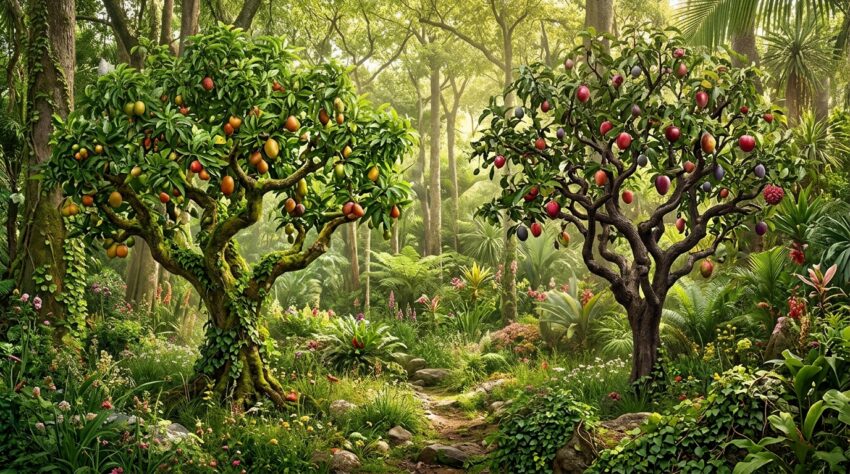
In this post we look at the background, the preamble, and the scene prior to the fall. It is a brief, transitory phase between the culmination of the creation and the beginning of the fall. Earth was an idyllic, albeit transitory place where innocence reigned supreme and creation was blemishless at its full blossom. All was serene, calm and orderly. Birds were chirping, man and beast alike were frolicking and freely partaking of the bounty God endowed them with on the young earth. It had a perfect, harmonious order with Adam at the apex of God’s creation and all the other creatures under his dominion. Adam was given the abundant fruits in the garden as his sustenance, and plants and herbs became the sustenance for the creatures (1:29-20). Everything that God had made on the earth was in perfect harmony and contentful. Eden in particular was a true portrait of the “Paradise of God” (Rev 2:7).
However, trouble was brewing in the background. Just as “darkness” brooded in God’s original creation (1:2), there was something brewing which was about to rupture this perfect harmony and concord between God and His creation. It’s instructive to examine the backdrop on the earth in its pristine state with its key players prior to the fall.
Man
At the apex of creation was Adam. His only responsibility was to “keep the garden” (2:15) to partake of the fruits from the trees which was inherently pleasant, as well as to adhere to God’s prohibition concerning the tree of knowledge of good and evil. This is diametrically opposed to the curse that followed after the fall where he was required to “toil” the fields to sustain himself (3:17).
Woman
In forming Eve, God had made a perfect counterpart for Adam who was to complement him in every way, making them the first couple. It’s worth remembering that God’s interdiction on not partaking of the tree of knowledge of good and evil was to Adam, and not to Eve. This is significant and we will revisit this point when we examine the fall.
Serpent
Although the first mention of the serpent is in the context of the fall, it’s worth considering what kind of a creature he was prior to the fall. The word “serpent” conjures up an archetypical image of a slithering reptile. But the serpent in Genesis before the fall is described as “more cunning than other beasts of field” (3:1). Furthermore, he’s contrasted with cattle and other beasts before being cursed to crawl upon his belly in 3:14. All of this indicates that it’s highly likely that the serpent prior to the fall was a majestic beast, and certainly more cunning than all others. That “cunningness” or wiliness became his Achilles’ heel that ultimately led to his downfall as we’ll see in a later section.
Garden
Finally, it’s helpful to take a closer look at the garden which was the epicenter of the fall. In it were all kinds of sightly fruit trees. In the middle of the garden, there were two prominent trees – tree of life and the tree of knowledge of good and evil. God expressly forbid Adam to eat of the latter, even to touch it (2:17, 3:3). We are told that Eve saw the tree of knowledge of good and evil as particularly delightful to behold and was attractive to her sight (3:16). However, no such mention is made of the tree of life. As a pure conjecture, the tree of life may not have been particularly attractive to behold. Doesn’t this correspond to the Christian experience as well as the Scriptures? The Lord Jesus is described as a “root out of dry ground with no attracting form” (Isa 53:2). Again, in Matt 7:13 it says “wide is the gate and the broad is the way that leads to destruction”. This strongly corroborates the fact that it’s rather easy to approach and partake of the tree of knowledge of good and evil, and less so with the tree of life.
In the following posts concerning the fall, we will examine more closely each one of the key player’s role and the impact each had on creation and human history.